
Stop Being Scared: A Guide to Generative AI for Book Images That Won’t Suck Your Soul
I have a confession: I’m completely addicted. My hard drive is now home to several hundred images of my novel’s world, characters, and darkest creatures, all conjured from nothing in the middle of the night. Using generative AI for book images has become my secret weapon, a tool so powerful it feels like cheating. I know what you’re thinking because I thought it too: “It’s not real art,” “I’m not a real author if I don’t do it all myself,” or the big one, “I can’t afford a real artist, but this feels… wrong.”
Let me tell you right now: that’s fear talking. Pandora’s Box is open. These tools exist, and they are getting exponentially better every single day. Authors who embrace this new world and learn to collaborate with a “silicone brain” will have an unbelievable advantage. Those who don’t, out of fear or misplaced pride, are choosing to fall behind. This isn’t about replacing human creativity; it’s about augmenting it to the absolute max.
Key Takeaways
- This guide helps fiction authors ethically and effectively use generative AI to create character art, book covers, and world visuals—without artistic skills or big budgets.
- Learn the best AI tools, prompt formulas for fantasy characters, and proven techniques to maintain visual consistency for your book series.
Table of Contents
- Why Every Author Needs Generative AI for Book Images (No, It’s Not Cheating)
- How Authors Actually Use AI Book Images
- Best AI Image Generators for Authors: Top Tools Compared
- How to Write Effective AI Prompts for Fantasy Book Characters
- Creating Consistent AI Characters: Techniques for Authors
- Frequently Asked Questions
- The Box is Open. Start Playing.
Why Every Author Needs Generative AI for Book Images (No, It’s Not Cheating)
The most common pushback I hear is, “But I do my own work.” I get it. We pour our blood, sweat, and tears into our manuscripts. The idea of letting a machine touch our world feels like a betrayal of the craft.
But here’s the reframe: you’re still doing the work. In fact, you’re doing more work.
You are the creative director. The AI is your tireless, infinitely skilled intern who can paint in any style imaginable. It can’t create without you. It has no story to tell, no emotional core to draw from. It only has data. You have the soul. You bring the vision, the character history, the world’s lore, the mood, the pain, and the triumph. Your prompts are the conduit for that vision.
Using AI for character art with AI or to visualize a scene isn’t a shortcut; it’s a new form of development. It helps you see your world more clearly, solidify character designs, and create a visual language for your story that was previously only accessible to authors with massive publisher budgets. This isn’t just about marketing; it’s about deepening your own connection to your work, guided by the core principles of storytelling you already know.
How Authors Actually Use AI Book Images
- Concept Art: Visualize characters, creatures, and locations during the drafting phase to keep your descriptions consistent.
- Social Media Content: Create an endless stream of teasers, character reveals, and atmospheric art to engage readers.
- Book Cover Mockups: Rapidly prototype dozens of cover concepts before hiring a designer for the final layout.
- Interior Illustrations: Add a professional touch to special editions or chapter headings without breaking the bank.
- Marketing Materials: Generate stunning visuals for ads, bookmarks, and other promotional items, like I detailed in my previous post on using generative AI for marketing.
Best AI Image Generators for Authors: Top Tools Compared
The landscape of AI image generators changes fast, but for authors, the key is finding tools that prioritize detail, artistic control, and ease of use. You don’t need to be a tech wizard. You just need a good imagination.
| Tool | Best For… | Why It’s Great for Authors |
|---|---|---|
| Perplexity Labs | Batch creation & rapid brainstorming. | I love this for pure ideation. I can write a prompt and get 25 different interpretations back. It’s fantastic for finding a visual direction when you’re just starting out. |
| Nano-Banana (via Gemini) | High-quality, artistic images. | If you have a Gemini Advanced subscription, this is a hidden gem. The quality is stunning, and it’s great for creating up to 10 polished, portfolio-worthy images at a time. |
| Midjourney | Unmatched artistic style & community. | Still the king for many. Its “style” is iconic, and the community on Discord is a fantastic place to learn prompting from others. It has a steeper learning curve but the results are often breathtaking. |
How to Write Effective AI Prompts for Fantasy Book Characters
This is where the magic happens. A good prompt is a recipe. It’s a blend of subject, style, lighting, and composition. It’s the difference between a generic, plastic-looking CGI character and an image that bleeds atmosphere.
Case Study: The ‘Spore’ Infected
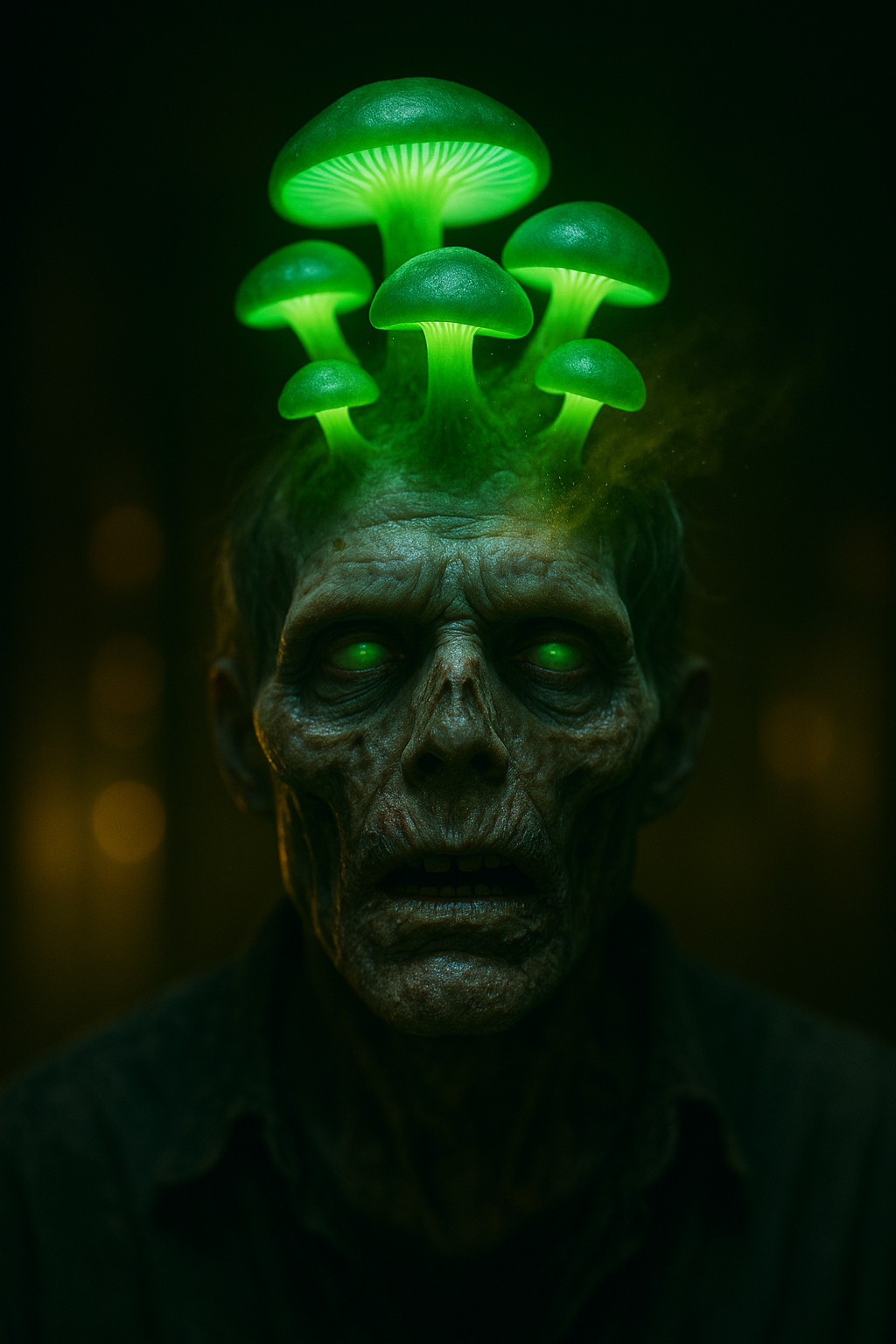
Example Prompt: Hyper-realistic cinematic portrait of a gaunt, undead man. His skin is desiccated and pale, with deep-set, haunted eyes that glow with a soft green light from within. Sprouting from his scalp are a small cluster of vibrant, bioluminescent green mushrooms, casting an ethereal glow on his face. The lighting is dark and moody, chiaroscuro style, inspired by the work of Rembrandt and Caravaggio. The focus is sharp on his eyes. Shot with a 85mm f/1.4 lens, photography, macabre, dark fantasy art.
Prompt Recipe: [Subject] + [Key Details] + [Lighting Style] + [Artistic Inspirations] + [Technical Specs]
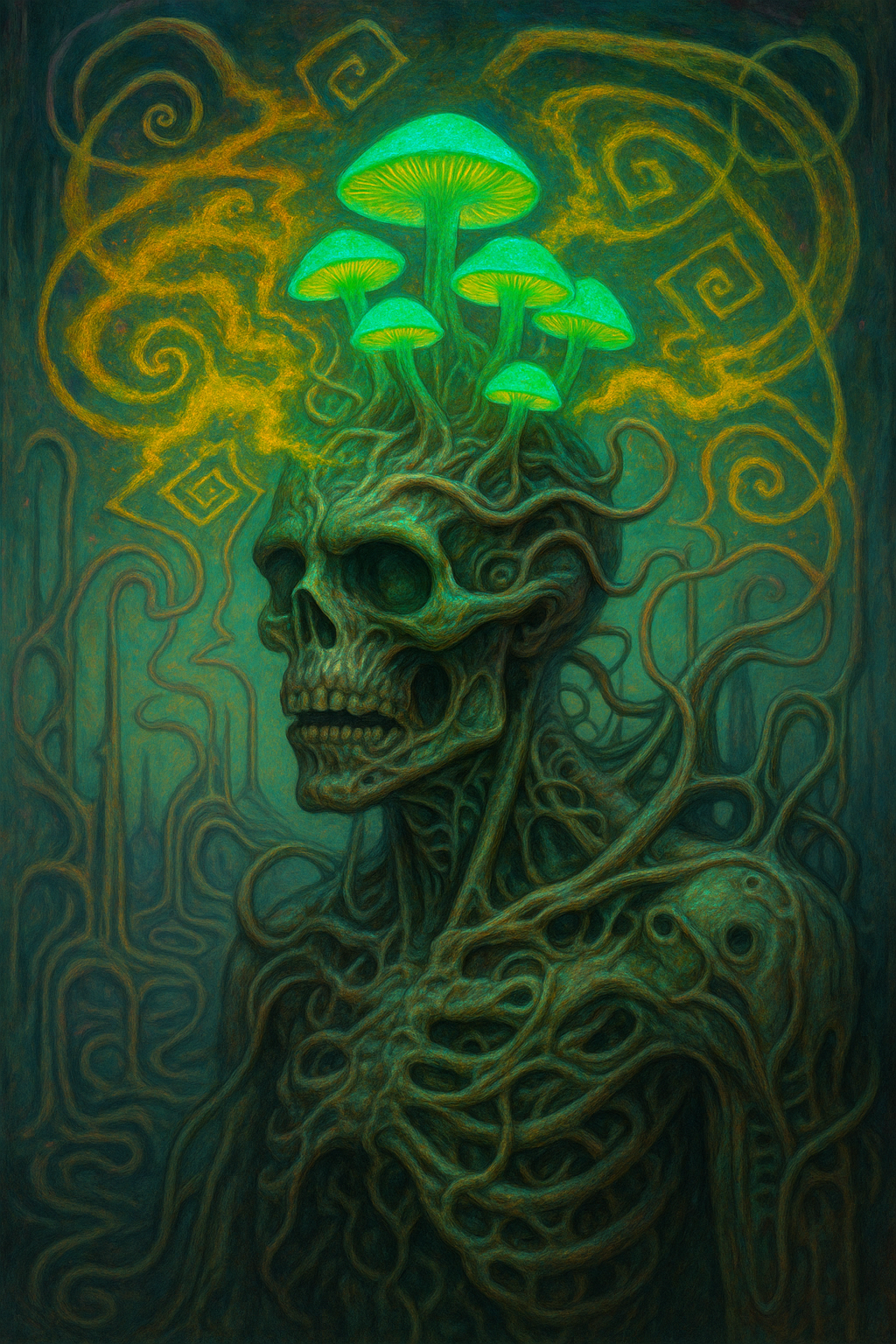
Example Prompt: An intricate dark fantasy illustration of a skeletal figure whose body is composed of interwoven, gnarled roots and vines. A crown of glowing green mushrooms sits atop its skull. In the background, mystical golden energy swirls in intricate, Celtic-knot-like patterns. The style is a blend of Zdzisław Beksiński’s dystopian surrealism and the organic detail of H.R. Giger. Muted color palette of deep teals and mossy greens, contrasted by the vibrant gold and green light.
Prompt Recipe: [Subject Composition] + [Background Elements] + [Style Mash-up] + [Color Palette]
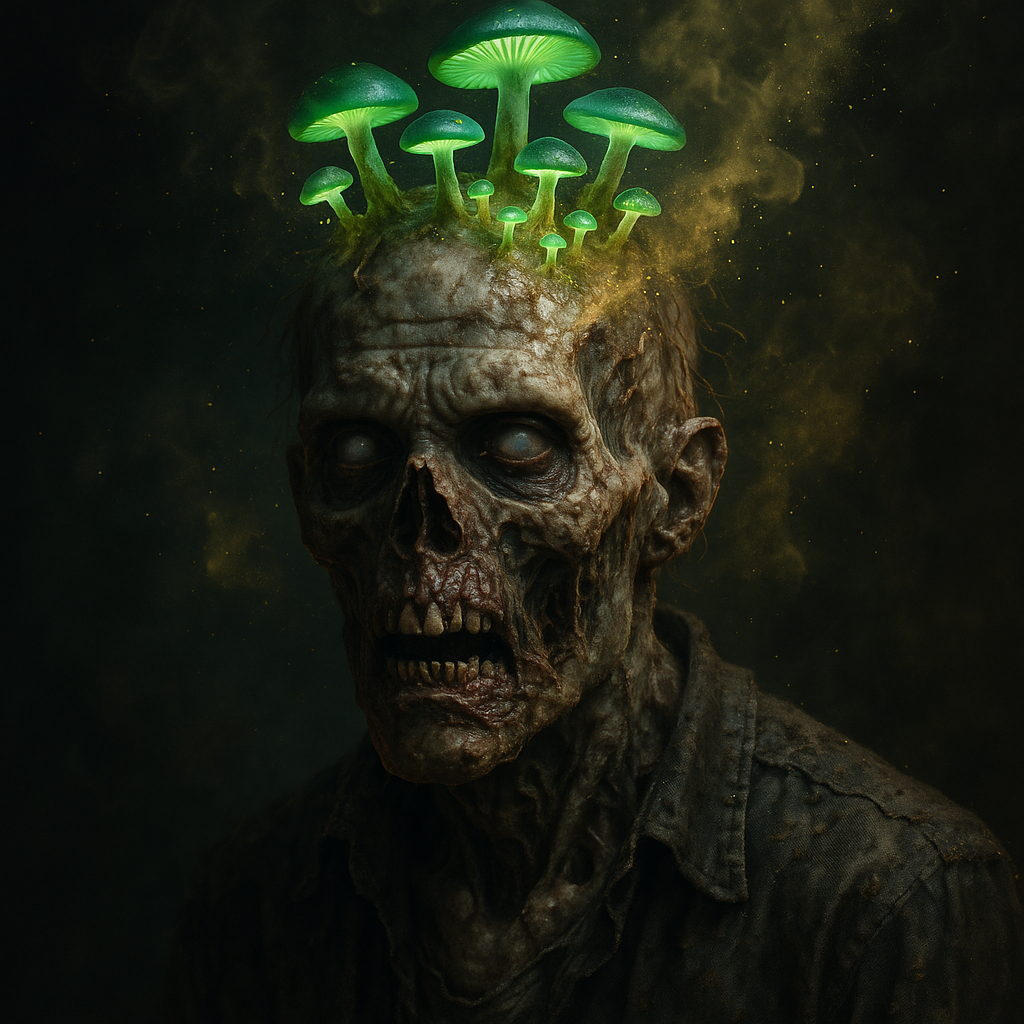
Example Prompt: Dark fantasy art, medium shot of a decaying zombie in a tattered shirt. Glowing green mushrooms on its head are releasing a thick cloud of yellow-green, bioluminescent spores that catch the light. The look on its face is vacant horror. The atmosphere is heavy and dark, with subtle volumetric lighting catching the floating spore particles. Style of Brom and Frank Frazetta, gritty, textured, high-detail.
Prompt Recipe: [Genre & Framing] + [Subject & Action] + [Atmosphere & Lighting] + [Artistic Style]
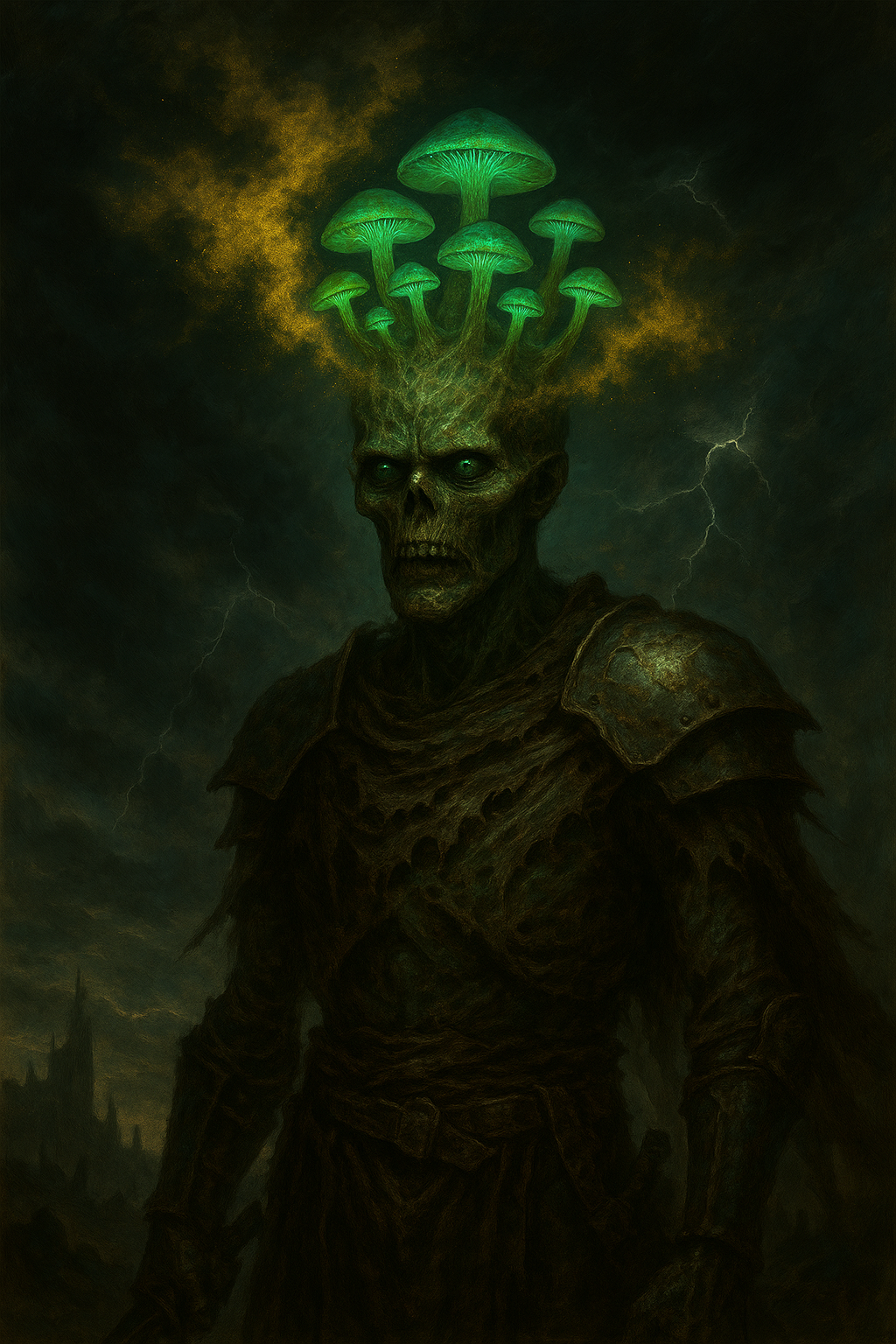
Creating characters means thinking about their roles and history. What does an infected knight look like? This required adding elements like armor and a more imposing stance, drawing from classic character archetypes.
Example Prompt: Epic fantasy digital painting of a menacing undead knight. The figure is tall and gaunt, clad in decaying, pitted plate armor. Its head is a skull-like visage crowned with glowing green mushrooms, and its eye sockets burn with green light. Above its head, a storm of golden energy crackles like lightning against a dark, stormy sky. The scene is dramatic and full of foreboding, style of a Magic: The Gathering card illustration by Seb McKinnon.
Prompt Recipe: [Genre & Medium] + [Subject & Details] + [Environmental Effects] + [Specific Artistic Style]
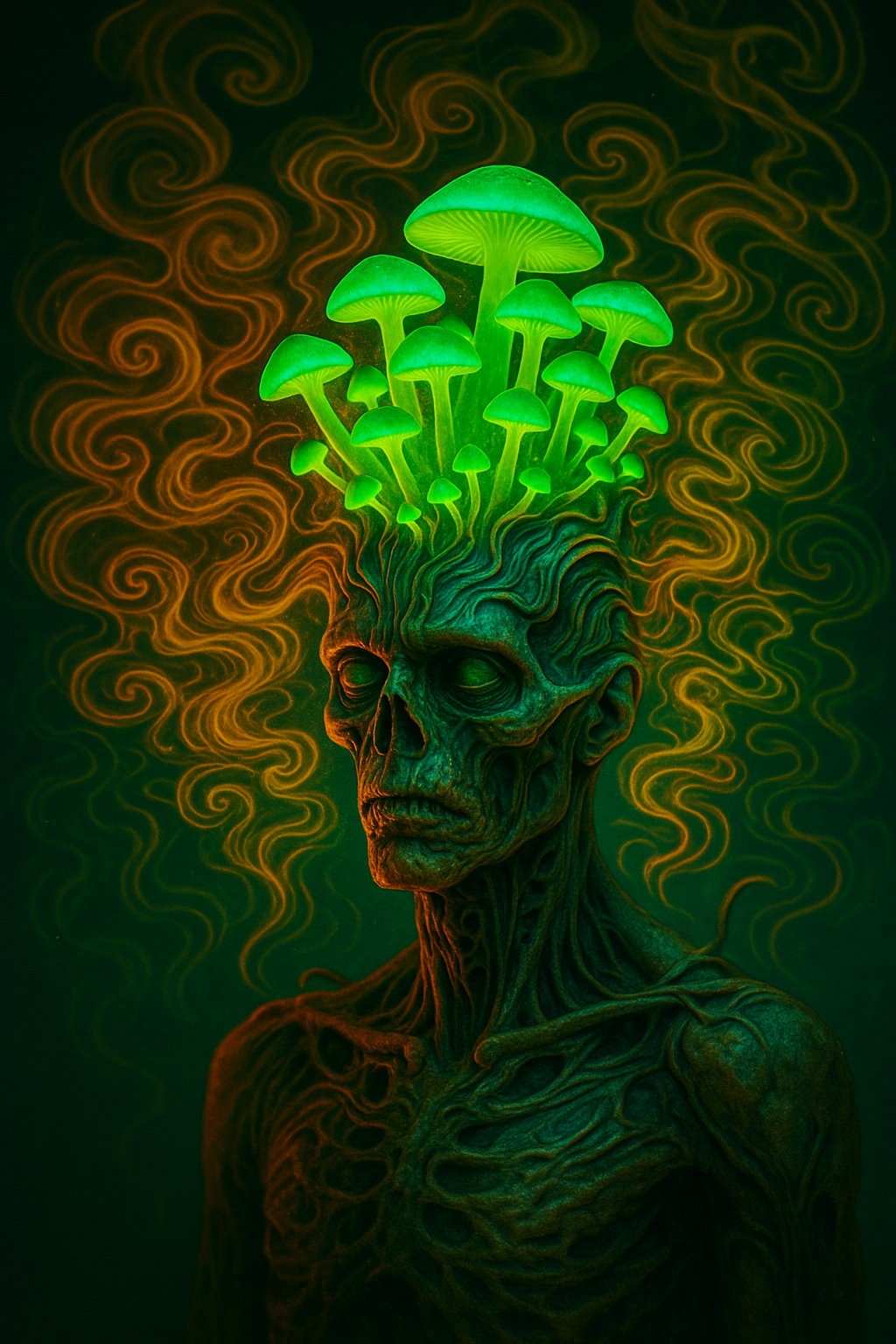
Example Prompt: Surrealist dark art portrait of a being whose head and shoulders are formed from a lattice of dark, interwoven roots. A crown of luminous green mushrooms grows from its head. The background is filled with thick, swirling, undulating lines of fiery orange-gold energy, like smoke or ectoplasm. The lighting is dramatic, with the figure in shadow, backlit by the intense glowing patterns. Style inspired by the visionary art of Alex Grey.
Prompt Recipe: [Art Movement] + [Subject Composition] + [Background Description] + [Lighting] + [Artistic Inspiration]
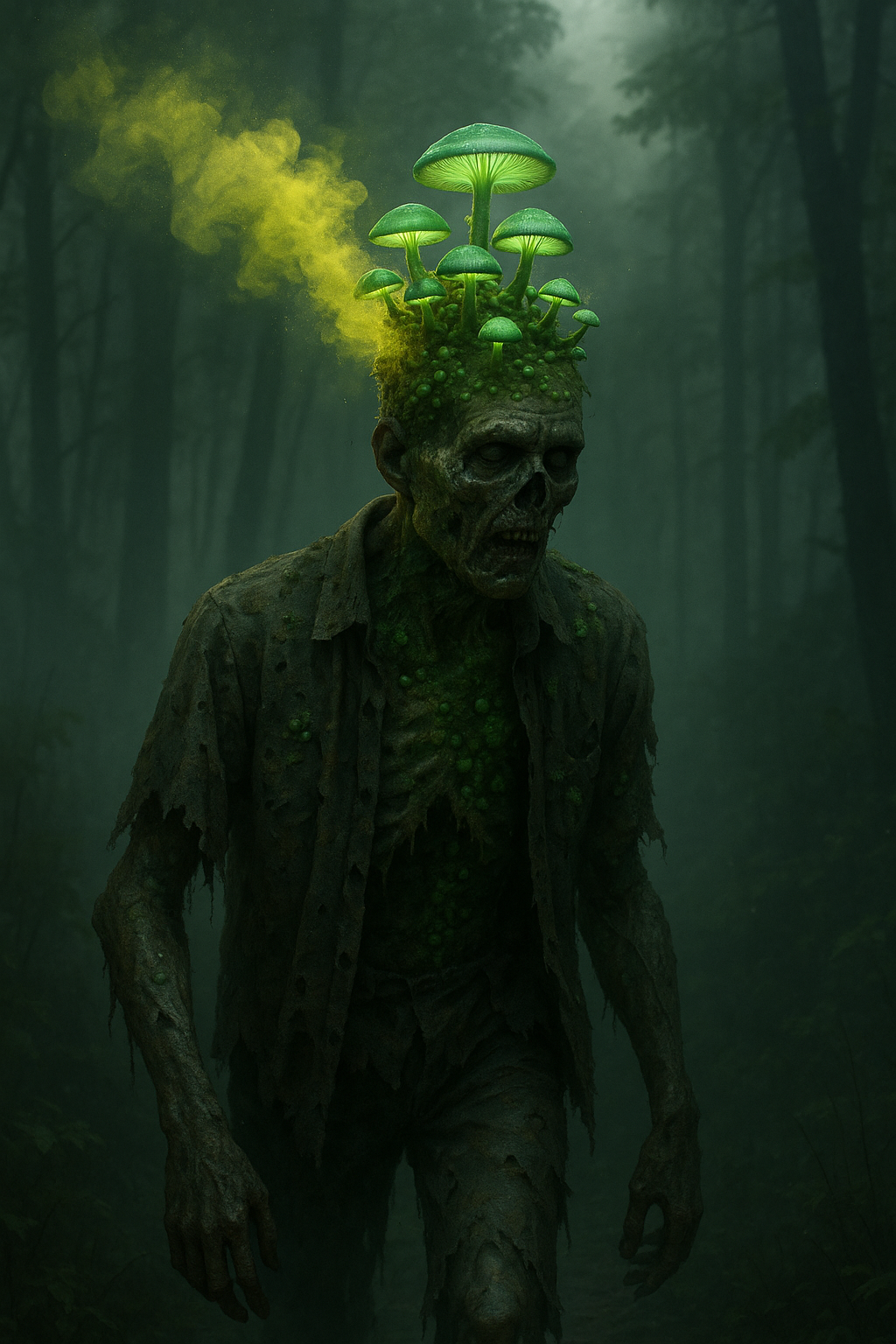
Example Prompt: Atmospheric scene of an infected zombie walking through a dark, misty forest at twilight. The figure is shambling, its clothes are ragged, and its skin is covered in patches of moss and fungus. The glowing green mushrooms on its head emit a trail of sickly yellow-green smoke that hangs in the damp air. The forest is dense with ancient trees and a thick ground fog obscures the forest floor. Cinematic, moody, horror concept art, shallow depth of field.
Prompt Recipe: [Atmosphere & Setting] + [Subject & Action] + [Key Details & Effects] + [Genre & Technical Specs]
Creating Consistent AI Characters: Techniques for Authors
Okay, so you can make a cool-looking character. But how do you make the same character again for the next scene? This is the biggest challenge for authors, and getting it right is a game-changer.
- Create a Character “Sheet” Prompt. This is your most important asset. Create a text file where you define your character with an obsessive level of detail. Don’t just say “brown hair.” Say “shoulder-length, wavy chestnut brown hair with coppery highlights, often tied back in a messy bun.” Include details about their face, eyes, scars, tattoos, signature clothing, and even their default expression.
- Use That Sheet Every Time. Start every single prompt for that character with your detailed character sheet. Then, after that block of text, add the specifics for the new scene: “…, sitting at a wooden table in a dimly lit tavern,” or “…, standing on a cliff overlooking a stormy sea.”
- Reference the Original Image (Image-to-Image). Many tools allow you to upload an image as part of your prompt. Once you have a definitive “hero” image of your character, use it in subsequent prompts. This gives the AI a powerful visual reference to work from, dramatically increasing consistency. You can often control the “strength” of this reference, allowing for variations in pose and expression while keeping the core features.
- Keep the Artist/Style References the Same. Don’t prompt for a “photograph” in one image and a “painting by Frank Frazetta” in the next. Maintaining a consistent artistic style is just as important as maintaining the character’s physical features.
Consistency takes practice, but it’s the key to moving from creating random cool pictures to building a professional-grade visual library for your book, one that you can use for everything from social media to creating stunning AI book cover art. If you’re looking for ideas to get you started, check out these inspiring fiction prompts.
Frequently Asked Questions
Can I ethically use AI-generated art for my book without getting sued?
This is the big, thorny question. While the legal landscape is still evolving, you can operate ethically and reduce risk. The biggest concerns are copyright and job displacement. For copyright, always check the terms of service of the tool you’re using—most grant you commercial rights to the images you create. The ethics of AI models training on existing art is a massive debate, but as an end-user, your primary responsibility is transparency. Be honest with your readers about how you created your art. Don’t pass it off as a human painting. For many indie authors who could never afford a human artist, AI is a tool of empowerment, not replacement.
What’s the best AI image generator for a fiction author on a budget?
For authors on a budget, the best tools are often those with generous free tiers or subscription models that offer a lot of value. Perplexity Labs and Gemini’s Nano-Banana (with a Gemini Advanced subscription) are fantastic starting points. While Midjourney is often considered the gold standard for pure artistic output, its subscription cost can be a factor. The key is to experiment with the free versions and find the one whose style and workflow best match your creative vision before committing.
I’m not tech-savvy; is AI image generation hard to learn?
Not at all! While there is a deep rabbit hole of advanced techniques, the basics are incredibly simple. If you can describe a scene in your book, you can write a prompt. The learning curve is mostly about discovering which words and phrases get you the best results. Start simple, see what the AI gives you, and then add more details to refine your vision. The case studies in this article are a great place to start learning.
Can I sell a book with an AI-generated cover on Amazon KDP?
Yes, you can. As of late 2024, Amazon KDP’s policy requires you to disclose the use of AI-generated content in your book, including the cover. When you upload your book, there will be a section where you can indicate that your cover art was created with the assistance of AI. As long as you are transparent and follow the terms of service of the AI tool you used to create the image, you are well within the guidelines.
The Box is Open. Start Playing.
Look, this technology can be intimidating. But it’s also an infinite playground. It’s a way to bring your vision to life in ways that were impossible for most of us just a few years ago. Don’t let fear of the unknown keep you on the sidelines.
You are a storyteller. This is just a new, unbelievably powerful way to tell your story. So jump in. Make a mess. Create something terrible. Then create something beautiful. Your silicone brain is waiting for your direction. And when you’re ready for another perspective, check out my manuscript review service, or see what happened when I put my own work under the microscope in an AI-powered autopsy of my memoir.
What about you? Have you tried using AI for your book projects? Share your biggest win or your most hilarious failure in the comments below!
About the Author
Joseph R. Long (Sumo) is an independent author with over a decade of experience in the trenches of self-publishing. He has navigated the brutal landscape of finding affordable editors, drumming up beta reader interest, and wrestling with the challenges of the modern author. He is a firm believer that AI is not a threat to be feared, but a Pandora’s Box that can never be closed. Instead of fighting the tide, he is embracing AI as a transformative tool for writers. While he uses AI as a ruthless editing partner and a brainstorming associate, all of his writing is his own. The Amos Report was born from his conviction that every author deserves access to the kind of brutally honest feedback that forges good stories into great ones.

 Sumo Sized Ginger