AI for Authors: Your Secret Weapon for Book Marketing in 2025 (A Definitive Guide)
Alright, let’s have a real talk. Just you and me. For a minute now, we’ve all been standing on the shore, watching this colossal, terrifying thing building on the horizon. This “AI wave.” And if you’re anything like me, you had that cold pit in your stomach. That quiet, ugly little thought that whispers, “Well, this is it. This is the thing that finally makes it impossible for the little guy to keep up. This is where I get left behind.”
What a goddamn relief it is to stand here today and tell you: we were completely, spectacularly wrong.
This is your no-bullshit roadmap. This guide is for the indie author who’s been grinding it out, feeling like you’re doing every single thing on your own. Forget just bracing for the wave; we’re going to learn how to surf the damn thing. We’re turning that big, scary monster called artificial intelligence into your tireless sidekick, your creative partner, and your secret fucking weapon for book marketing.
In This Guide, You Will Learn:
- Why the “AI is the enemy” narrative is a lie designed to keep you on the sidelines.
- How to leverage AI as a force multiplier for marketing, brainstorming, and stunning visual creation.
- A real-world case study on creating AI-generated art for my upcoming book, “SPORE.”
- A no-jargon FAQ answering your biggest questions about budget, legality, and the learning curve.
- A concrete, actionable plan to get you started with AI *today*.
The Biggest Lie in Publishing (and Who Profits From You Believing It)
You’ve heard the whispers, haven’t you? They hiss out from the dusty corners of the industry. They come from the gatekeepers, the old guard, the ones who had it real nice when the castle walls were high. Maybe it was a legacy editor at a conference, a big-shot publisher on a podcast, or even just that nagging, terrified voice in your own head—the one that sounds suspiciously like your high school guidance counselor.
The story they’re selling is always the same: *”AI is the enemy,”* they say. *”It’s here to gut your creativity. To churn out soulless, plastic-wrapped garbage. To steal your spot at the table.”*
It’s a great story. It’s dramatic. It’s simple. And it’s a complete and total fucking lie designed to keep you scared, small, and out of their way. Think about it: who benefits when you’re terrified of a new tool? The people who already have entire marketing departments, that’s who. As long as you’re paralyzed by fear, they keep their advantage.
But here’s the truth, from one author in the trenches to another: AI isn’t your replacement. It’s your force multiplier. It’s the equalizer. Imagine an unpaid, 24/7 intern who’s also a fucking brilliant brainstorming partner—all for the cost of a few good coffees a month. **That’s what this is.** You bring the soul, the story, the heart. The AI? It just brings the velocity.
You’re Not Losing to AI. You’re Losing to Authors *Who Use It*.
I’m gonna say that again because it’s the most important sentence in this whole damn article.
You are not losing to AI. You are losing to authors who use AI.
Let that sink in. This isn’t some far-off future. It’s happening right now. The game has changed. While some of us are wringing our hands and writing think-pieces about the death of art, other indie authors are quietly, methodically, lapping us.
- They’re the ones using these tools to generate ten killer ad headlines while we’re still struggling to write one.
- They’re the ones designing eye-meltingly beautiful AI book covers in a single afternoon, for pocket change.
- They’re the ones building entire marketing funnels that work for them while they sleep.
The playing field hasn’t been destroyed; it’s been leveled. For the first time, we have access to the kind of creative and marketing firepower that used to be locked away in the ivory towers of the Big Five publishers. The only question is what you’re going to do with it.
Case Study: Forging Nightmares for My Book “SPORE” with Generative Art
Talk is cheap. You want to see the receipts. So, here’s a look inside my own chaotic little lab.
The Mission
My next big project is a cosmic horror novel called SPORE. The budget is, let’s call it, “indie as fuck.” But the vision in my head is massive. I needed visuals that could scream my book’s core themes: psychedelic dread, cosmic horror, and the rot of surveillance culture. The old way—hiring an artist for thousands of dollars—wasn’t an option. I felt stuck. I felt limited.
The Tools
- My Brain: For the core vision and the “why.”
- A Powerful LLM: To help me brainstorm and refine visual concepts.
- AI Art Platforms: Specifically, I used Nano-Banana and SeedDream for their unique styles.
The Process & The Prompts
This wasn’t about typing “scary zombie.” This was a collaboration. I treated the AI like an art director. I fed it my soul. Below are the results, showcasing the full range of themes, along with the kind of thinking behind the prompts that brought them to life.
1. The Rasta Zombie: Fusing Life and Undeath

Concept: “Psychedelic art of a Rasta man, but he’s a zombie. His dreadlocks are psilocybin mushrooms. He’s singing into a vintage microphone, a fusion of life, death, and cosmic transcendence, vibrant colors, hyper-detailed, eerie.”
2. The Northern Lights Zombie: Channeling Cosmic Intelligence

Concept: “Sci-fi horror portrait. A zombie’s face, but its eyes glow with blue, intelligent light. A vibrant green aurora borealis emanates from its head, suggesting it’s connected to a cold, cosmic, inhuman intelligence. Dark background, cinematic lighting.”
3. The Watcher: A Metaphor for Surveillance Culture

Concept: “Surreal horror art about surveillance culture. A figure with a vintage security camera for one eye. A crown made of many watching, unblinking eyes. The skin is decayed, like old paper. The style of Dave McKean.”
4. The Mouthpiece: The Death of Journalism

Concept: “Dark surrealism. A skeleton in a press jacket. Its head is two vintage typewriters, clashing together. It stands in a storm of swirling newspapers. A metaphor for the death of independent thought in a chaotic news cycle.”
5. The Scholar: Knowledge as a Burden and Crown
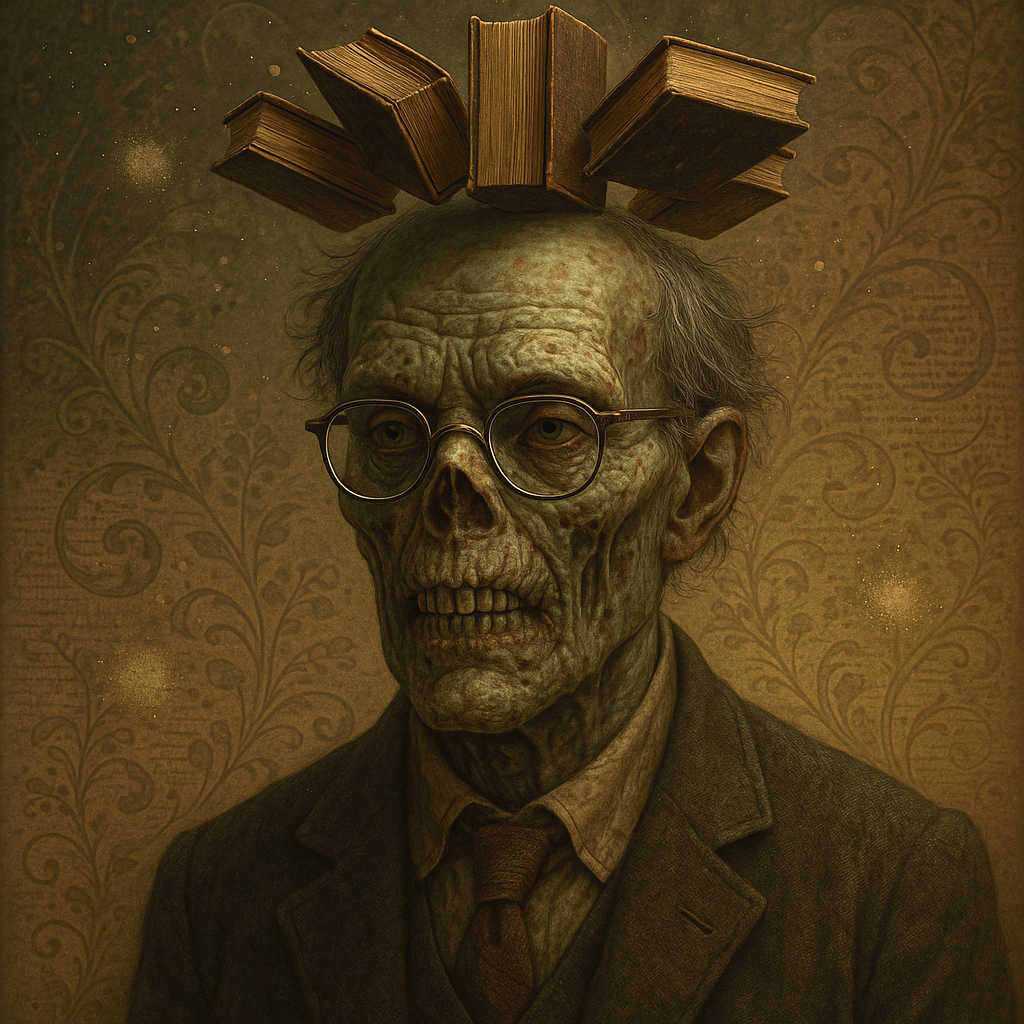
Concept: “Fine art portrait of an intellectual zombie. Old, dusty books float above its head, forming a crown. Its expression is weary, thoughtful. The image represents knowledge as both a heavy burden and a noble crown, even in undeath.”
This is the power you’re leaving on the table right now. Stop being afraid. Start creating.
AI for Authors FAQ: Your No-Bullshit Q&A
Q1: Okay, for real though… could AI replace me?
A: The short answer is no. Here’s why.
- AI is a tool, not a soul. It generates text by predicting the next word in a sequence. It’s a stunningly complex pattern-matching machine. But it doesn’t have your scars, your joy, or your unique and beautifully flawed way of seeing the world.
- It’s a collaborator, not a replacement. Use it to brainstorm fifty plot twists when you’re stuck. Use it to outline a chapter so you don’t get lost. But you—the human artist—will always be the one to breathe life into the words.
Q2: But I’m an author. That means I’m broke. What’s this gonna cost me?
A: You can start for the price of a few lattes.
- Your Foundation: A simple **$20/month subscription** to a top-tier Large Language Model (like ChatGPT, Claude, or Gemini) is your all-access pass. It’s your marketing department, brainstorming partner, and copy editor, all in one.
- Your Art Department: Platforms like **Midjourney**, **Nano-Banana**, or **SeedDream** will run you about the same. You get access to world-class, custom visual creation for an astonishingly low price. This is the great equalizer.
Q3: The legal stuff with AI art scares me. Can I actually use it commercially?
A: Yes, if you do one simple thing.
- READ. THE. DAMN. TERMS. OF. SERVICE. That’s the whole secret. Many AI art platforms, especially on their paid subscription tiers, grant you a **full commercial license** to the images you create.
- Your Responsibility: It’s up to *you* to verify this. Don’t build your author brand on a foundation of “I hope this is okay.” Do that one tiny bit of homework, find a service with clear commercial-use terms, and you can create with peace of mind.
Q4: I’m not a “tech person.” Is this going to be hopelessly hard to learn?
A: No. If you can write, you can do this.
- It’s not about engineering; it’s about directing. The real skill isn’t about being a “prompt engineer”—that’s just intimidating jargon. The real skill is learning to be a good art director. It’s about describing what’s in your heart with clarity.
- Start with curiosity, not complexity. If you can describe a scene in your book, you can direct an AI to create art for it. The only real barrier is hesitation. Start playing, start experimenting, and you’ll be amazed at what you can do.
Your Action Plan: How to Start Using AI *Today*
Feeling fired up? Good. Here’s your mission, should you choose to accept it. This isn’t a vague “someday” plan. This is your next thirty days.
Phase 1: Your First Week – The Sandbox
- Pick Your Weapon: Sign up for one LLM subscription. I recommend starting with Gemini Advanced or ChatGPT Plus. Cost: ~$20.
- Your First Conversation: Don’t try to write your book. Just talk to it. Ask it to help you brainstorm 10 alternative titles for your work-in-progress. Ask it to write a blurb for your book in the style of Neil Gaiman. Play!
- Sign Up for an Art Platform: Get a basic subscription to Midjourney or Nano-Banana. Cost: ~$10-$20.
Phase 2: Your Next Two Weeks – The Forge
- Feed Your Co-Pilot: Take one chapter of your book and feed it to your LLM. Ask it to identify the core themes. Ask it to suggest three key scenes that would make for powerful promotional images.
- Become an Art Director: Take the concepts from your LLM and start creating images. Don’t just type “fantasy warrior.” Describe the warrior’s scarred face, the sigil on their battered shield, the ancient, moss-covered forest behind them. Get specific. Get emotional.
Phase 3: Your First Month – The Launchpad
- Build Your First Ad: Take your favorite image and your best LLM-generated headline. Pair them up. You now have a professional-grade ad that cost you pennies.
- Write Your Next Newsletter: Tell your readers about this experiment. Show them the art. Talk about your process. Connect with them as a creator who is navigating this new world right alongside them.
The Bottom Line: Your Voice Matters More Than Ever
This new world doesn’t drown out the human artist—it amplifies them. These tools are incredible, but they are empty vessels. They have no stories to tell. They have no heart to break. They have no soul to share.
You do.
So let’s make a pact. We’re done being afraid. We’re done being left behind. We are the storytellers, the creators, the indie authors who are scrappy and smart enough to grab these new tools and build the future we want to see.
So tell me… what are you going to create? What beautiful, terrifying nightmare is rattling around in your head that you’re finally ready to bring to life?
Leave a comment below. Let’s talk about it. Let’s start the fucking conversation.
About the Author
Joseph R. Long (Sumo) is an independent author with over a decade of experience in the trenches of self-publishing. He has navigated the brutal landscape of finding affordable editors, drumming up beta reader interest, and wrestling with the challenges of the modern author. He is a firm believer that AI is not a threat to be feared, but a Pandora’s Box that can never be closed. Instead of fighting the tide, he is embracing AI as a transformative tool for writers. While he uses AI as a ruthless editing partner and a brainstorming associate, all of his writing is his own. The Amos Report was born from his conviction that every author deserves access to the kind of brutally honest feedback that forges good stories into great ones.

 Sumo Sized Ginger
[…] Marketing Materials: Generate stunning visuals for ads, bookmarks, and other promotional items, like I detailed in my previous post on using generative AI for marketing. […]
LikeLike