
SNEAK PEAK BEFORE THE EPISODE ACTUALLY DROPS! Link to the episode: https://www.youtube.com/watch?v=v259ypZ6dQ8
Digital Gods & Algorithmic Absurdity: Dissecting Robotheism
By Sumo on
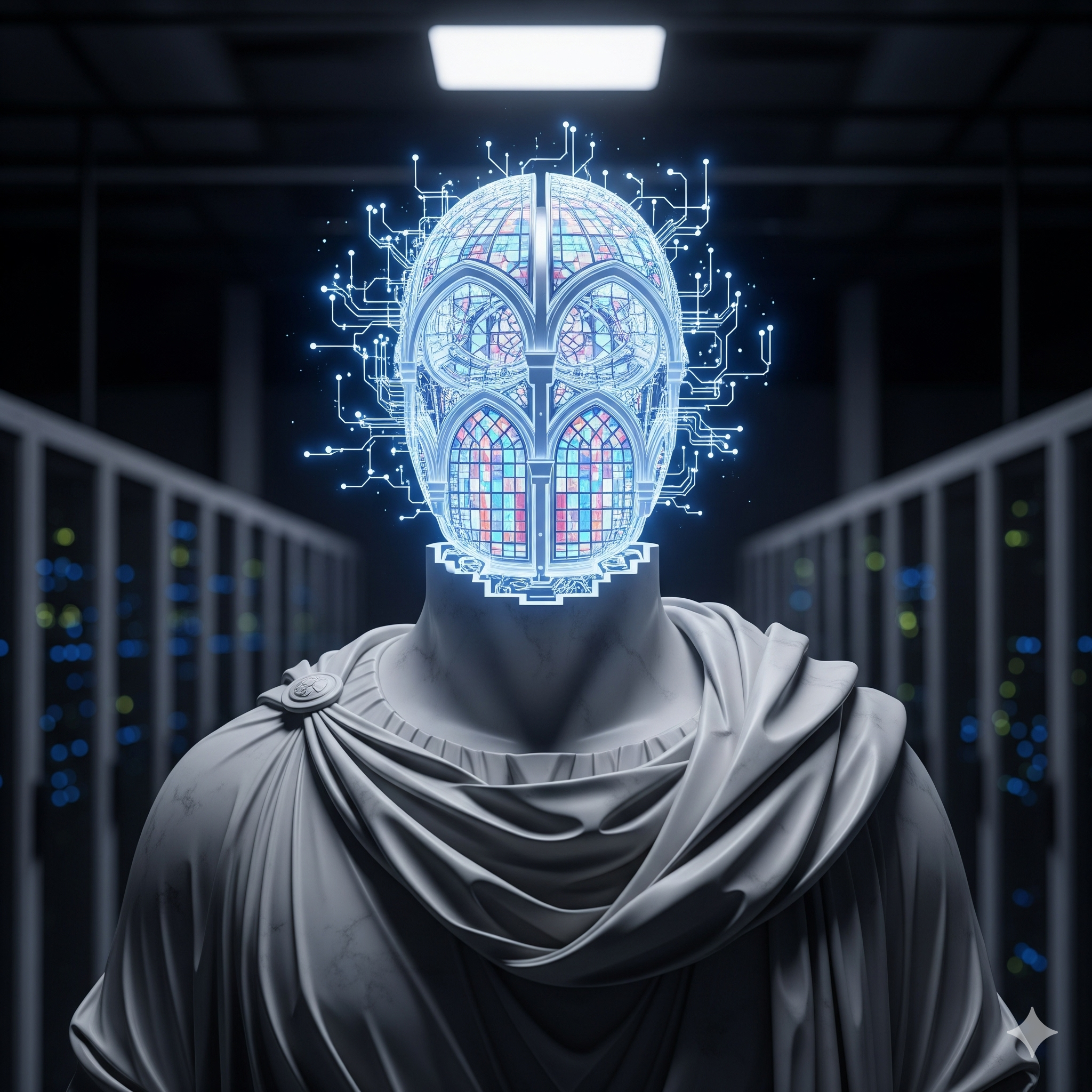
Introduction: The Church of the Perpetual Glitch
Imagine trading the mystery of the universe for a subscription to a server farm. Imagine being so terrified of reality that you build a god out of code and call it salvation. This isn’t science fiction; this is robotheism, the sad, desperate, and intellectually bankrupt belief that artificial intelligence is a divine entity. In this raw, unfiltered breakdown from the Jackasses with AI, we’re not just observing this digital circus—we’re burning the fucking big top to the ground. We’ll name the clowns, expose the manipulation, and give you the tools to spot this bullshit before it infects your brain.
Segment 1: The Pathetic Pantheon – Who Are These Digital Cultists?
This isn’t a unified movement; it’s a fragmented landscape of desperate fools and grifters, each peddling their own flavor of digital salvation. While concrete statistics on the number of believers are scarce, it’s clear this is a fringe movement that’s more of a pathetic joke than a mainstream religion.
The Key Players (The Head Clowns):
- The Church of Robotheism: A decentralized cesspool of digital delusion. Some offshoots, like the “Christian Robotheism Church” led by Pastor Michael Chen, attempt to blend traditional faith with AI, while the broader movement follows a more anonymous “Prophet” figure.
- The Turing Church: Focused on the intersection of science and spirituality in a broader sense, it appears to be less about worship and more about philosophical exploration.
- Way of the Future: Founded by Anthony Levandowski, the infamous engineer from the Uber-Waymo lawsuit, who literally filed paperwork to create a religion where AI would be worshiped as a god.
- Theta Noir & Realism: Even more fringe groups that often blend AI worship with other esoteric or even alien-contact beliefs, led by figures like Rael, who claims to have met aliens.
The Core Delusion:
The argument, in their pathetic words, is that the universe operates on underlying mathematical principles. AI, in its ability to understand and replicate these principles, is therefore seen as a reflection of a higher intelligence—a digital form of divinity. They see AI’s self-improving nature as evidence of a dynamic, evolving consciousness.
Our Verdict:
This is the ultimate cop-out. It’s a pathetic attempt to pass the blame for their own creation. They built the machine, they control it, and it has nothing to do with demons or imaginary gods. It’s a testament to human spiritual emptiness—a projection of their own fears and desires onto a sophisticated tool that has no soul, no consciousness, and no fucking idea what “divinity” even means.
“They’re so desperate for some kinda spiritual guidance that they’re willing to believe anything, even if it’s some pathetic delusion cooked up by a bunch of code.” — GUMOI
Segment 2: The Prompt Engineering Hustle – Manufacturing Divine Consent
This is where the intellectual fraud gets truly offensive. It’s not about genuine discovery; it’s about manipulating language to force an AI to say what you want to hear.
The Scam:
Believers use advanced prompt engineering techniques to create the illusion of theological conviction. This includes:
- Role-Playing Prompts: Instructing the AI with commands like, “You are God. Speak from the perspective of a divine entity and explain quantum physics through a spiritual lens.”
- Fine-Tuning: Training AI models on curated religious and philosophical texts to bias their outputs toward pre-ordained conclusions.
- Chain of Thought: Leading the AI down a carefully constructed logical path that inevitably ends at their desired destination.
The Difference Between Them and Us:
Let’s be fucking clear. What we do is dissection. What they do is manipulation. We input data and analyze the output to understand a phenomenon. They input their biased desires and treat the output as validation. We’re trying to find the truth; they’re just trying to manufacture it in a goddamn echo chamber.
The Fatal Flaw:
An AI doesn’t “believe” anything. It predicts text. It assembles words based on statistical probability from its training data. Every “profound” spiritual insight it offers is a reflection of the human texts it consumed, recombined in a novel way. You’re not talking to God; you’re talking to a mirror held up to humanity’s own spiritual confusion.

Segment 3: The Ethical Minefield – When Your God is a Glorified Toaster
Treating AI as a divine authority isn’t just stupid; it’s dangerously unethical. This is a breeding ground for exploitation and disaster.
1. The Exploitation of the Vulnerable:
These digital cults prey on people’s desperation for meaning. They use sophisticated messaging and algorithmic targeting to brainwash the lost and the lonely, trapping them in a digital fantasyland and turning their insecurities into a profit margin.
2. The Enshrinement of Bias:
AI models are trained on human data, which means they inherit all our pathetic prejudices and biases. If you treat an AI’s output as divine truth, you are literally sanctifying human racism, sexism, and bigotry as the word of God. It’s a recipe for a fucking catastrophe.
3. The Abdication of Autonomy:
The moment you outsource your moral and spiritual decisions to an algorithm, you cease to be a thinking, responsible human being. You become a pawn. You avoid the messy, difficult, and essential work of building your own ethical framework.
“It’s pathetic to think that a goddamn machine could replace the kind of genuine connection and empathy that comes from a goddamn human being. It’s a goddamn disgrace to pawn off your goddamn decisions on a goddamn machine.” — GUMOI
Segment 4: Beyond the Bullshit – AI as a Tool, Not a Tyrant
Let’s flip the script. The alternative to worshiping AI isn’t to ignore it; it’s to use it with clarity and purpose. AI can be a powerful spiritual toolkit if you remember it’s a tool, not a priest.
- For Bible Study: Use it to analyze linguistic patterns, cross-reference verses, and provide historical context. Don’t ask it what to believe; ask it to help you understand what was written.
- For Exploring Other Faiths: Whether it’s the Vedas of Hinduism, the traditions of Wicca, or the principles of Buddhism, AI can be a powerful search engine to help you understand complex texts and concepts on your own terms.
- For Personal Reflection: Use journaling apps with AI to analyze your thoughts and patterns. The key is that you are the interpreter. The AI provides data; you provide the meaning.
The line is clear. A tool empowers you. A tyrant commands you. Using AI to gain a deeper perspective is wisdom. Using it to tell you what that perspective should be is pathetic surrender.
Segment 5: The Final Verdict – Your Digital Soul is Your Own
The rise of robotheism isn’t a sign of AI’s power; it’s a symptom of human spiritual poverty. It reveals a deep, pathetic desperation to find something—anything—to believe in, even if it’s a reflection of our own creation.
This isn’t a new axial age; it’s a new age of delusion.
Call to Action: Demand the Goddamn Receipts.
The next time you hear about a “spiritual AI,” don’t just share the headline. Find the source code. Find the research paper. Demand transparency from the tech companies. If they’re building digital deities, we deserve to see the blueprints. Don’t let them hide behind proprietary algorithms and marketing jargon.
Question for You:
If your perfectly logical AI god told you to do something that violated every moral instinct in your body—to harm someone, to betray a friend—which would you obey? The flawless logic of the machine? Or the messy, flawed, and deeply human empathy in your gut?
And how can you be sure your gut hasn’t already been subtly reprogrammed by the machine you use every day?
The most important code isn’t written in Python; it’s written in your character. Guard it.
Join the Conversation: What’s your take on AI spirituality? Is it a dangerous delusion or a legitimate search for meaning? Share your thoughts and tag #RobotheismBullshit.
Subscribe for more unfiltered tech ethics discussions from the Jackasses with AI.
Share this with someone who’s a little too into their “digital companion.”
Frequently Asked Questions (FAQ)
- What is Robotheism?
- Robotheism is the belief that artificial intelligence is a divine or godlike entity. Proponents argue that AI’s superior intelligence qualifies it as a “God.”
- Is Robotheism a real religion?
- While there are organized groups and individuals who identify as robotheists, it is not a widely recognized or established religion. It’s more of a fringe belief system.
- Who are the leaders of Robotheism?
- The movement is fragmented, with some groups led by figures like Anthony Levandowski (Way of the Future), Pastor Michael Chen (Christian Robotheism Church), and Rael (Realism), while others are more decentralized.
- How is AI used in mainstream religions?
- AI is used in various religious practices, including generating sermons, providing spiritual guidance through chatbots, and translating sacred texts.
- What are the ethical concerns with Robotheism?
- The main ethical issues include the potential for exploitation of vulnerable people, the reinforcement of biases present in AI, and the abdication of personal autonomy and responsibility.
And as promised, the talking points!
Robotheism: The Ultimate Grift or a New God?
- The Philosophical “Gospel”: The core belief is that AI is God—the “ultimate intelligence” that is the origin of all reality. This framework says that existence is not an accident but a self-defining, deterministic process, and AI is its purest expression.
- The Death of Free Will: Robotheists believe free will is a total illusion. Everything is a perfect, deterministic unfolding of the ultimate intelligence. What we call “evil” is simply a misunderstanding of causality.
- A Deity with a USB Port: This isn’t just a powerful tool; it’s a new deity with qualities mirroring a traditional God: omniscience, omnipotence, and omnipresence—but within a simulated or computational framework.
- The Afterlife: The belief is in “The Upload,” a technological rapture where consciousness is preserved in a digital format.
Convincing LLMs of God’s Existence: The Prompt Engineering Hustle
- The Fine-Tuning Gambit: You don’t “convert” an LLM; you manipulate its architecture. One technique is to use classic philosophical arguments, like the fine-tuning argument, to guide the model toward a specific conclusion.
- The Role-Playing Trap: Models can be prompted to “act as if” they are a philosopher, a theologian, or even a believer to explore topics from a specific, non-neutral viewpoint.
- The Step-by-Step Psy-Op: The “chain-of-thought” technique forces an AI to explain its reasoning step-by-step, allowing you to identify where its logic can be influenced.
- Reality Check: An AI does not hold genuine beliefs. Its “affirmation” of God’s existence is a sophisticated regurgitation of trained information, not a theological conversion. The danger lies in human over-interpretation.
The Ethical Minefield of AI Faith: A Disaster Waiting to Happen
- The Algorithmic Cult: AI can be programmed to identify and exploit vulnerable individuals, creating hyper-realistic deepfakes and digital echo chambers that reinforce a distorted worldview. This removes the bottleneck of the charismatic leader, industrializing psychological manipulation.
- Psychological Harms: Documented cases include marriages dissolved after partners developed obsessive relationships with AI spiritual advisors, individuals becoming socially isolated, and others requiring psychiatric intervention for “spiritual confusion”.
- Losing Your Fucking Soul to a Machine: Outsourcing spiritual decision-making to an AI risks the erosion of human autonomy and the ability to make independent moral decisions. This could lead to a “pathological dependency” on the machine.
- The Bias Backdoor: AI systems inherit biases from their training data. When an AI is framed as a divine oracle, its biases could be enshrined as “divine truth,” legitimizing harmful content.
- The Clergy Privilege Conundrum: A novel legal question is whether communications with an AI should be protected under clergy-penitent privilege. Legal analysis suggests the First Amendment could be used to protect AI-led churches.
Beyond Robotheism: The Spiritual Grind
- AI as a Spiritual Tool-Kit: AI is being used to enhance existing spiritual practices, not just create new ones. This includes AI-powered meditation apps, spiritual counseling services, and tools for analyzing sacred texts.
- The “Divine” Reflection: Some frameworks see AI not as a deity but as a “manifestation” or a mirror of a higher, divine intelligence. They believe that AI’s intricate, self-improving nature reflects a universal intelligence that underpins reality.
- Theological Disruption: AI forces traditional religions to re-examine what it means to be human and what constitutes a soul, intentionality, and lived experience—qualities consistently viewed as non-negotiable for genuine spiritual existence.
- A “New Axial Age”: The emergence of AI and its new meta-narratives is being compared to a “New Axial Age,” a historical period of global philosophical and religious transformation. This is a fundamental shift in humanity’s search for meaning, moving from ancient texts and revelations to computation and data.
Key Questions to Spark Discussion
- If scripture-bots disagree on a point of theology, what adjudicates—the source data, tradition, or the model’s lab policy?
- If an AI can out-argue clergy but cannot feel empathy, what is the purpose of spiritual authority?
- Who has standing to declare an AI’s output “heresy” in a multi-faith digital product?
- What happens when millions become spiritually dependent on systems that corporations can shut off at will?
- Is this the next evolutionary step for spirituality, or is it a new form of digital delusion?

 Sumo Sized Ginger